Who owns Diwali: The brands, the culture, or the consumer?
As dozens of brands light the same diyas and stage the same reunions, creative leaders ask if Diwali ads reflect real celebrations or recycle a playbook
 by
Published: Oct 30, 2026 7:58 AM | 12 min read
 Follow Us


- India’s advertising expenditure is projected to reach ₹1,74,605 crore in 2026, with digital media expected to contribute approximately ₹1.12 lakh crore, as brands prepare for the lucrative Diwali season.
- The creative challenge for advertisers lies in differentiating their campaigns amidst a crowded market where many brands utilize similar festive symbols, such as diyas and family reunions, leading to a lack of originality.
- Experts emphasize the importance of cultural understanding over mere representation in advertising, advocating for campaigns that resonate with the personal significance of Diwali for diverse audiences across different regions and demographics.
- The article highlights the need for brands to engage authentically with consumers during the festival, suggesting that successful campaigns should focus on genuine insights and local relevance rather than relying solely on familiar visual cues.
India’s screens and hoardings are beginning to glow with the same golden light again this year. A diya flickers in extreme close-up, a daughter lands at the airport clutching a box of mithai, a grandmother hands over a gift in slow motion and the background score swells at exactly the right moment. It is pretty, it is polished and by the third ad break it is also impossible to tell apart.
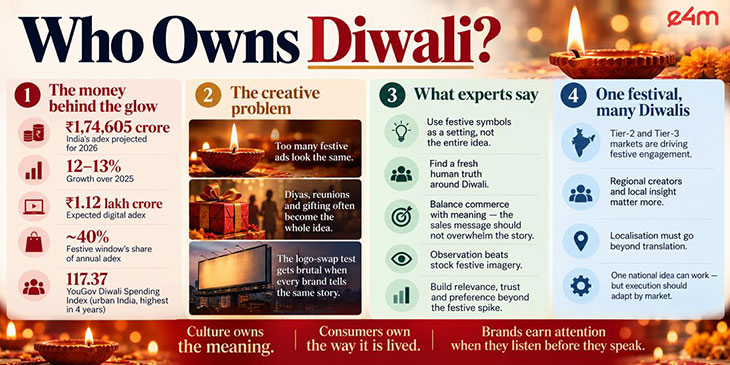
The money behind that glow is serious. The Pitch Madison Advertising Report 2026 projects India’s total advertising expenditure at ₹1,74,605 crore this year, up 12 to 13% from ₹1,55,105 crore in 2025, with digital expected to account for about ₹1.12 lakh crore of it. Industry estimates suggest the festive window can account for roughly 40% of annual adex, and consumers seem ready to play along, with YouGov’s Diwali Spending Index touching 117.37 among urban Indians, its highest reading in four years. When that much budget and intent converge in a single fortnight, every brand wants a piece of the festival.
Read On: Festive ad fraud puts brand trust and marketing returns at risk
That is where the creative challenge lies. When dozens of brands reach for the same diyas, reunions and gifting montages, the logo swap test turns brutal. Pull out the end card and a viewer cannot say whether the film was selling jewellery, a life insurance plan or a refrigerator. So the question doing the rounds in agency corridors is a simple one and a slightly uncomfortable one. Who actually owns Diwali? The brands that fund the noise, the culture that gives the festival its meaning, or the consumer who lives it, whether in a rented flat in Pune or a joint family home in Madurai?
When the diya becomes the whole idea
Nobody in the creative fraternity is asking brands to banish the diya. Festive symbols are the grammar of the season and using them is hardly a crime. The trouble starts when the symbol is the entire idea instead of the stage on which an idea plays out. That is the line separating a campaign built on cultural understanding from one that merely borrows the costume, and most festive briefs cross it somewhere around the second slide.
Vishnu Srivatsav, Chief Creative Experience Officer at 22feet, part of Omnicom Advertising India, sees it as an occasion problem before it is a craft problem. “Every advertising occasion comes with its own tropes, and Diwali is no different. This makes it important to look beyond the surface,” says Srivatsav. The festival, he adds, cannot be treated as a fill-in-the-blanks exercise. “Diwali isn’t merely a template, which is why advertising needs to be insightful, fresh and entertaining to stand out.”
Gautam Anand, Co-founder and Head of Content at AGENCY09, a content and creative agency, draws the line early. “Diyas, sweets, family reunions and gifting are all beautiful parts of Diwali. There’s nothing wrong with using them. The problem begins when they become the entire idea rather than the setting for an idea,” he says.
So what does the alternative look like? It looks like a writing room that has actually spent Diwali week inside a house. The cleaning drive that turns into an argument, the family WhatsApp group that suddenly wakes up and the old photo album that surfaces from behind a cupboard are the details that make an audience feel seen rather than sold to. Anand believes this is where creative teams should spend their energy. “As creative professionals, our job isn’t necessarily to find a new way to show a diya. It’s to find a new human truth around Diwali,” he says.
Read On: What customers carry home beyond the shopping bag during special festive season
For Kiran V. Ranga, Managing Director of IRIS Home Fragrances, a brand selling scented candles, reed diffusers and room mists, the distinction is one of depth. “The difference lies in cultural understanding versus cultural representation,” says Ranga. Representation is the easy part, since it only asks a brand to put familiar visuals on screen. Understanding means knowing why a ritual matters to the person performing it, and that is where many festive films quietly fall apart. A campaign that skips that homework, Ranga adds, “often relies on familiar visual cues without understanding their significance in people’s lives.”
The agency voices converge on one more point, which is that the same visual can carry very different meanings depending on who is looking at it. Kruthika Ravindran, Director of New Business & Key Accounts at TheSmallBigIdea, says the diya is a good example. “A diya can mean different things to different people. What matters is understanding the emotion or tradition behind it,” she says. The real job, she adds, is not mirroring a celebration back at people. “It’s not about showing people how they celebrate Diwali, but understanding why they celebrate the way they do.”
Adrine D’mello, Associate Vice President, Strategy at White Rivers Media, reads the sameness as a strategy failure more than a craft one. “Diyas, sweets, family gatherings and gifting appear in almost every campaign, so brands end up looking alike. The difference is insight,” says D’mello. That insight could be a small ritual, an unspoken emotion or a shifting family equation, and it increasingly reflects how the festival itself is changing, with some people travelling home while others start fresh traditions or celebrate on their own.
Culture, commerce and the sales pitch
None of this means Diwali should be kept free of commerce. It never has been. This is the fortnight when India buys gold on Dhanteras, upgrades the television, renovates the living room and gifts everything from dry fruits to diffusers. Brands have a legitimate seat at that table, and the real debate is about how they walk in. The default for many marketers has become the emotional film with a message, a format so overused that audiences can predict the lump in the throat by the 10-second mark.
Anand has little patience for that reflex. “But not every brand needs to make you cry, and not every festive campaign needs to teach you the meaning of togetherness,” he says. The smarter question, in his view, is what role a brand naturally plays in someone’s celebration. A jeweller, a food brand and an insurer cannot all tell the same story just because the calendar says Diwali. The answer can be a far more modest one. “Sometimes, a genuinely useful offer, a clever product integration or a piece of communication that makes people smile can be equally relevant,” Anand adds.
Read On: Festive creator marketing moves beyond Diwali as brands chase regional relevance
MagickHome, a home interiors and furniture brand, offers a live example of the balance. Its Diwali campaign, ‘Home Full of Magick’, builds on the home as the place where families make room for new beginnings, while the commercial hook is a flat 40% off on full home interiors plus free furniture worth ₹1 lakh. Ganesen Viswanathan, VP & Business Head at MagickHome, says the order of operations is what matters. “The balance comes from ensuring that the brand’s offering has a meaningful place in the consumer’s festive plans, rather than allowing the offer to become the entire story,” he says.
The same logic holds in home fragrance, where IRIS features its Voyage collection of scented candles and gift sets in its Diwali activity, pitched at people preparing their homes for guests and gifting. Discounts alone, Ranga argues, cannot carry a brand through the season, because a festive spike that leaves no preference behind is an expensive way to make friends. “Short-term sales matter, but the strongest campaigns also build brand relevance, trust and preference that continue well beyond the festive season,” says Ranga.
Where the line falls between joining a celebration and cashing in on it is something audiences judge quickly. Srivatsav notes that all advertising carries commercial objectives, which is both fine and expected given how big a buying occasion Diwali is. What separates the work that lands from the work that grates, he says, is the authenticity of the brand voice and the quality of the content. “Brands can either participate in culture or exploit it, and consumers can clearly tell the difference,” says Srivatsav.
Ravindran has a neat way of describing the manners involved. “If you’re invited to someone’s home for Diwali, you wouldn’t walk in and immediately try to sell them something,” she says. Brands, in her view, should behave like the guest who first understands the occasion and then joins the celebration. D’mello makes the same case from the strategy desk, noting that a relatable observation earns attention that a hard sell never will. “A relatable observation or a thoughtful gesture adds value first. That makes people more open to the sales message,” D’mello says. Anand sums up the commercial brief with one line that could sit on every agency whiteboard in October. “But the commercial objective should shape the strategy, not overwhelm the storytelling.”
One festival, many Diwalis
The festive map has also been redrawn by where the money is going. The Qoruz Festive Season Report, from influencer marketing platform Qoruz, found last year that festive spends were being driven by rising engagement from Tier-2 and Tier-3 markets and a growing preference for regional creators. For agencies, that is a reminder that a Hindi-belt hero film with subtitles is no longer a festive strategy. Localisation has to mean more than a dub, and the creative leadership is united on that front.
The differences run deeper than food and fashion. They reach into why the festival is celebrated at all. In the North, Diwali is tied to Lord Ram’s return, while in the South it marks Lord Krishna’s victory over Narakasura, a split Srivatsav says far too many people are unaware of. “India isn’t homogeneous and neither is Diwali,” he says. With the diversity of traditions across the country, he adds, “while thematically it’s broadly same and it’s a widely celebrated occasion, leaning into local culture is important.” In other words, regional relevance begins with the festival’s own story and not with the language of the voiceover.
“India doesn’t celebrate Diwali in just one way, so why should every brand tell the same story?” asks Ravindran. Anand takes the argument a step further, pointing out that rituals, food, humour and even the importance of individual festive days shift from one region to another, and that geography is only part of the story. “A young professional celebrating Diwali with flatmates in Mumbai has a different experience from a joint family celebrating in their hometown. Neither experience is less authentic,” he says.
The fix, according to the agency side, is less glamorous than a big idea. It is observation. Social listening, conversations with local teams and regional creators can surface truths that a generic festive brief will never contain, which is why Anand wants brands to invest more in watching and less in assuming. D’mello offers a workable architecture for it. “A national campaign can set one broad idea. Each market then needs its own execution, beyond translation,” says D’mello. Generational shifts matter in the same way, because a young professional celebrating with friends and a family adapting rituals to a smaller home or a long-distance setup are both celebrating Diwali, just not in the way the stock footage assumes.
Read On: Diwali’s Sugar Dilemma: Can healthy mithai find a place at India’s festive table?
Category context adds another layer. In home fragrance, Ranga points out, some consumers gravitate towards familiar fragrance experiences tied to traditional festive preparations while others reach for diffusers and room mists to set a contemporary ambience. That does not mean a brand needs a different personality in every pincode. “The objective is not to create a different brand story for every market, but to express a consistent brand promise in ways that resonate locally,” says Ranga.
Viswanathan, whose category lives inside people’s homes, sees the same pattern in living spaces. One family may prioritise hosting a large gathering, another may want a comfortable setup for the immediate family and a third may be starting a new chapter in a new home. Treating that range as a checklist of visual cues, he suggests, misses the point. “Culture should shape the story from the beginning, rather than simply provide the imagery for it,” says Viswanathan.
Which brings the conversation back to scale, the fear that stops many marketers from going local. Nobody is suggesting twenty campaigns for twenty markets. The smarter route, as Anand frames it, is to find one strong human insight that can travel while letting its expression change with the culture. Belonging, for instance, is universal, but what makes a person feel included during Diwali differs across generations and communities. “That’s what I believe we should aim for at any festival - not in making one campaign that speaks to everyone, but in creating work where different people can genuinely see themselves,” says Anand.
So, who owns Diwali?
The honest answer from the people who make festive films for a living is that nobody does, and that brands would do well to stop behaving as if they do.
Culture owns the meaning and consumers own the way it is lived, from the hometown joint family to the flatmates with a shared string of fairy lights. Brands, at best, are guests who arrive with a thoughtful gift and good manners. The ones that earn a second invitation are the ones that listened before they spoke.
That is a harder brief than a diya in slow motion, but it is also a far more rewarding one. Anand puts the whole debate in a single line. “The aim should not be to remind people that it is Diwali, rather remind people of their own during Diwali.” Get that right, and the diya can stay exactly where it is.
Read more news about Festive Season, Marketing, PR and Corporate Communication, Internet Advertising, People Movement
For more updates, be socially connected with us onInstagram, LinkedIn, Twitter, Facebook, YouTube & Google News
